
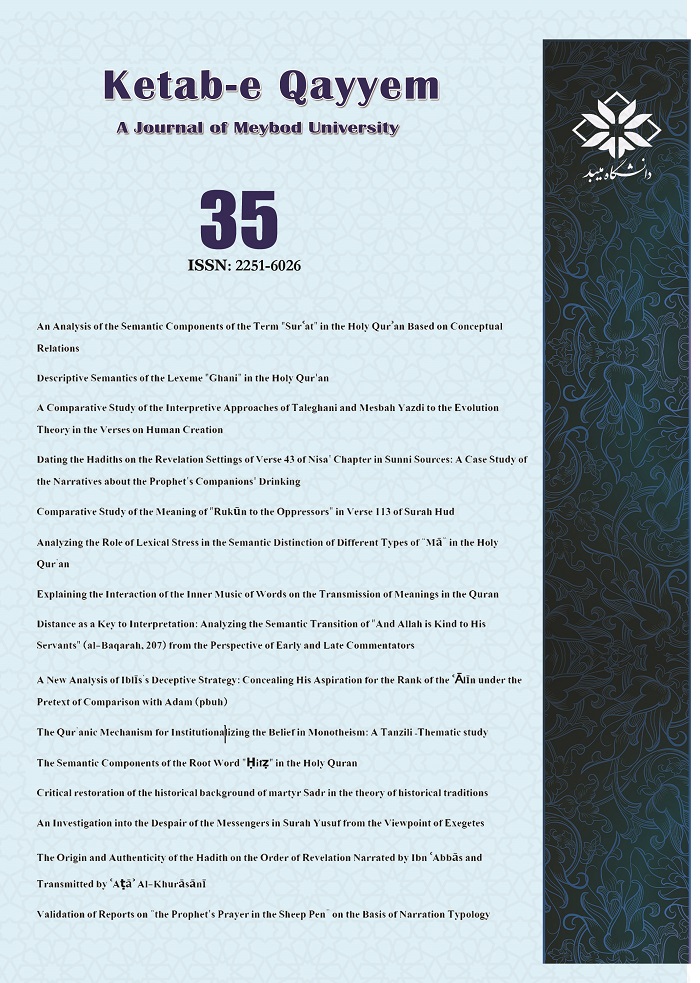
About the Journal
Ketab-e Qayyem is a peer-reviewed, scientific-research journal dedicated to advancing scholarly work in the fields of Quranic and Hadith Studies. Established under the official license of the Iranian Ministry of Science, Research and Technology, it is proudly owned, managed, and published by Meybod University.
Scope and Focus
The journal serves as a dynamic platform for original research and interdisciplinary discussions centered on the Islamic scriptural tradition.
Key areas of focus include:
Quranic Studies and Exegesis (Tafsir)
Hadith Studies
Linguistics and the Quran
The teachings (Ma'arif) of the Quran and Hadith
Historical studies related to the Quran and Hadith
Memorandum of Cooperation Agreement with the Scientific Association of Nahj al-Balagha Studies in Iran
Journal Information:
Type of Accreditation: Scientific (Ministry of Science, Research and Technology)
Publication Frequency: Biannual
Ranking by the Ministry of Science: Grade B
Type of Peer Review: Double-blind
Average Review Time: 4 months
Acceptance Rate: 10%
Journal Language: Persian (Abstracts in English)
Publication Type: Electronic - Offline
Citation Style: APA
Access Type: Open access to full-text articles
Subject Classification: Available
Review and Publication Fees: Applicable
Reviewer List: Year 2025 (1404)
Fonts and Required Files: Available
All manuscripts submitted to the Ketabe Qayyem system will be checked for similarity through plagiarism detection software (Samim Noor) before entering the peer review process.
Publication ethics: "Ketabe Qayyem" publication respects the rules of ethics in publications and is subject to the rules of the Committee on Ethics in Publication (COPE) and follows the executive regulations of the law on preventing and dealing with fraud in scientific works.
AI Policy Statement for Ketabe Qayyem
At ،Journal of Ketabe Qayyem we recognize the growing role of generative AI in scientific research and writing. While we welcome the responsible use of AI tools for tasks such as data analysis, language editing, and idea generation, authors must transparently disclose any AI assistance in their manuscripts. AI-generated content must be rigorously verified for accuracy, and all claims must be supported by original research. Authors retain full responsibility for the integrity of their work, and AI may not be listed as a co-author. Plagiarism, data fabrication, or misleading use of AI-generated content will not be tolerated. Our editorial team evaluates submissions with these guidelines in mind to uphold academic rigor and ethical standards.
Pages 1-18
oshriyeh oshriyeh, Mohammad Ali Khorrami, Seyyed Abdul Rasul Hosseinizadeh, Seyyed Mohammad Naqeeb
Pages 19-38
Vafa Mahfouzi Mousavi, Dr.Hasan Abdollahi
Pages 39-58
mohammad hoseinkhani, amirreza ashrafi
Pages 59-76
Mina Shamkhi, sima albooghobysh
Pages 77-97
Milad Monshi, ali mohammad mirjalili
Pages 99-118
Heidar far shrazi
Pages 119-137
Arefeh zahra Akbari,, Muhammad Soltani Renani, Seyyed Mahmood Tayyeb Hosseini,
Pages 139-158
Ali asghar Akhondy, Mohammad esmaeel Salehi zade,
Pages 159-180
mohammad hadi mansouri, Mohsen Fazel Bakhshayesh
Pages 181-204
narges ghasemi firooz abadi, seyyedeh vahjdeh rahimi
Pages 205-225
soheila jalali, Farideh Amini, fatemeh taghikhany
Pages 227-247
said Bahmani, Faranak Bahmani
Pages 249-267
Maryam Alizadeh
Pages 269-300
Saeideh Jannesari, Amir Ahmadnezhad, MohammadAli Mahdavi rad
Pages 301-320
Mohsen Deymekar, Zabiollah Asadi


